 By Matt Jabs
Making Dirt – Part 2
This is part two of a two part post on compost. Read part one – DIY kitchen compost bucket – here
That’s what we’re gonna call it. “I Got Worms!” We’re gonna specialize in selling worm farms. You know, like ant farms. ~ Lloyd Christmas
This quote from the movie Dumb and Dumber was basically the same direct and hilarious approach I used when proposing our soon to be “Worm Farm” to my wife. As you can imagine, she reacted with a sobering degree of skepticism – as any other sane woman may do when presented with the notion of her husband running a “Worm Farm” out of their garage.
To bring her along, like with many of my ideas, I simply had to explain the plan in detail, assure her that I was not going to quit my job to run the worm farm, let it marinate for awhile… then begin construction.
A Vermicomposting Worm Farm
Why in the heck would anybody want to make their own vermicomposting worm farm? Well, I’m glad you asked…
Wikipedia defines “verimicomposting” as follows:
Vermicompost, is composting utilizing various species of worms, specifically red wigglers, white worms, and earthworms creating the heterogeneous mixture of decomposing vegetable or food waste, bedding materials, and pure vermicast produced during the course of normal vermiculture operations. Vermicast, similarly known as worm castings, worm humus or worm manure, is the end-product of the breakdown of organic matter by the species of earthworm.
Containing water-soluble nutrients and bacteria, vermicompost is an excellent, nutrient-rich organic fertilizer and soil conditioner. The process of producing vermicompost is called vermicomposting.
This article is also a follow up on a promise I gave to several Five Cent Nickel readers in my “Breaking Free From a Culture of Temptation” article a few months back. I promised I would write a post detailing how I constructed my very own vermicomposting worm farm for very little money. In the original article I mentioned how I was tempted to purchase a vermicomposting bin rather than make my own. Here is the snippet from the original article:
A store-bought vermicomposting bin ($130) Instead of buying one, I decided to make my own. I spent just a fraction of what I would’ve paid in the store ($22), and it works great. I hope to put together an article about this soon.
Making my own vermicomposting worm farm — in order to enjoy the benefits of the nutrient rich soil — was very easy, inexpensive, and fun. In my opinion, it is always an awesome thing to save a boat-load of money AND enjoy the feeling of building something yourself. As I mentioned in my DIY kitchen compost bucket article, not everyone is into building things themselves. If that sounds like you then I recommend purchasing one of these two prefabricated vermicompost systems:
Prefabricated vermicompost bins
- The $130 option – The famous “Can-O-Worms” has a multi-level design that’s easy to assemble, easy to use, and can be kept both indoors or outdoors.
- The $100 option – The Worm Factory employs a tray system that automatically separates food scraps from finished compost. This system can also be used indoors or outdoors.
If I were not on a staunch mission to destroy my debt as soon as possible I would have probably gone with one of the above systems, but instead I opted once again for the DIY route! (Prices posted were taken at the time of writing.)
My Frugal DIY Vermicompost Bin
The $21 option – Here are the actual costs and necessary parts for making a vermicomposting worm farm for just $21:
- 2 dark, plastic, non-transparent 10 gallon storage bins – cost = $7
- A drill with ¼” and 1/16″ bits
- Shredded paper – I use a mix of paper from my shredder and newspaper
- Red wriggler worms – I bought a pound from a local source I found on CraigsList – cost = $15
- 4 equally sized blocks
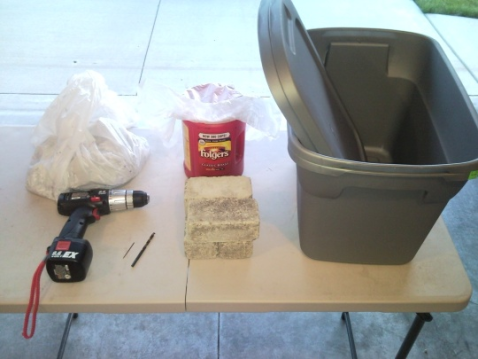
1. Start with your parts and tools (my worms are in the coffee can)
2. Drill 20+ ¼” holes on the bottom of both bins – for drainage and worm travel
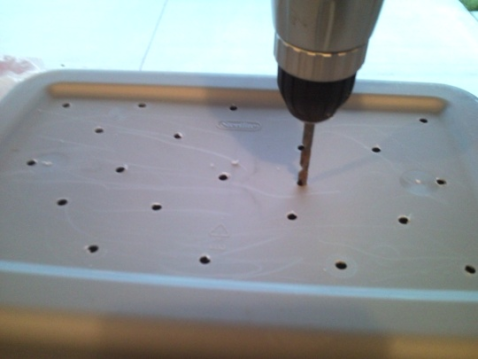
3. Drill 1/16″ holes along the side of both bins, near the top. Then drill 30+ 1/16″ holes in the top lid of ONE of the bins (not both)
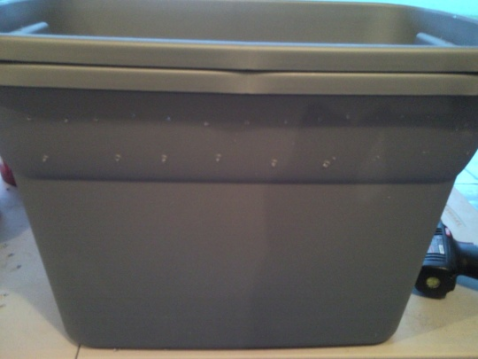
4. Place bedding in ONE bin only (leave other bin empty) – mix shredded paper with a shovel full of black dirt and spray with enough water to lightly dampen

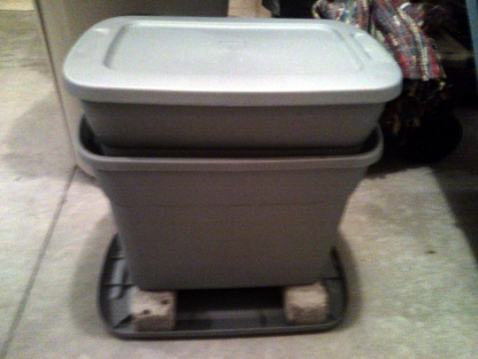
5. Add your pound of worms and stir it all up. Cover mixture with damp piece of cardboard then place the empty bin on top of the cardboard and cover with the ventilated lid. Place the non-ventilated lid upside-down, position your 4 blocks on top of it, then place the bins atop the blocks like so…
Some Detailed Info on our Worm Farm
The Jabs Worm Farm Inn has been successfully operating in our garage for over two full months now! (UPDATE: This worm farm was in operation for three years, providing us with rich compost for our garden and flower beds! When we moved out of state this worm farm was quickly snatched up by a fortunate responder to our CraigsList ad.)
We keep our DIY kitchen compost bucket under our kitchen sink until it is full, at which time we feed the worms by emptying the contents into the worm farm. Be sure to bury your food scraps so you do not attract gnats and other flies.
We only put organic food scraps in so that our soil can remain free of chemical pesticide residue. We are also careful in maintaining the balance of proper moisture in the bins. You do this by adding more shredded paper when the mixture gets too wet. You will know things are too moist if you start to notice odor or gnats.
Once the bottom bin is full you can simply start a new mixture in the top bin. Don’t worry about adding more worms, once they have exhausted their food supply in the bottom bin, they will naturally migrate up into the top bin through the ¼” holes you provided them.
Any excess “worm tea” will drain through the ¼” holes in the bottom bin and will collect on the upside-down lid. Once a good amount of liquid accumulates on the lid I simply dump this tea into a container and dilute with water and use to water the plants in my garden. It is a very powerful natural fertilizer.
For more detailed information about red wriggler worms and vermicomposting systems in general visit this informative article on Composting with Redworms.
*******



If there are holes in the bottom bin, what stops the worms from crawling out the bottom?
Thanks!
Because the food is in the bin.
I’m giving this a try to the dismay of my wife (she loves the science/nature part, not too thrilled of having worms in the garage/basement); I have it set up ready to go and the worms come tomorrow….Do the 1/16″ holes serve the purpose of aeration? Thx~Keith.
She may never be happy about the worms, Betsy never really was – BUT – she’ll thank you when you pull the juicy produce from your garden! Yes, the 1/16″ holes are for aeration. Did you make your bins and get started?
worms just arrived today, took longer than I thought (didn’t hit send on my payment–slap forehead!); will let you know how it goes…Thx again…
Learned a lot from the “dumb” questions and the answers. Thanks for a great job and detailed information.
I’ve been using only one bin and hate separating the worms from the compost.
This is an awesome project for my homeschooled kids! Can’t wait to get started. Love your website and thanks for all the sharing of knowledge in a day in age where everyone wants money just to share how to survive and bring back our green world. You make a God sent virtual community. Many thanks neighbor!
Have been worm farming for a while now and have started using Bokashi as well. I keep the Bokashi bucket in my kitchen and that works on the scraps (onion and citrus and leftover food etc as well) and when that has fermented (also no smell) I add it to my worm farm and they finish the job and love the fermented stuff. Am still having a problem with separating the worms from the vermicompost though but am persisting with the 2nd layer.
Hello Matt, I’m new at your website, and enjoy it very much. I learn here alot and get inspired. Thanks.
Don’t the worms get crashed by the upper bin? At least in the beginning of the process? Should I put inside some sort of stopper to avoid crashing?
Theoretically- I could leave the upper bin aside until the lower bin is almost full and only then offer fresh food in the upper bin and start the cycle?
Don’t the worms escape from the gaps between the two bins?
Aren’t you worried about ink/chemicals in shredded printed paper, either hurting the worms or being passed to the humus/compost and into the plants….
I apologize in advance for the multiple (possibly?) silly questions 🙂
Thanks
Amir
Got my totes and worms tonight for my worm farm!!
Cant wait to get started! Thanks for putting this info
on your site! I love it!
Tanya, you rock – let us know how it’s coming. God bless.
I just started a worm bin and followed your instructions however when I got home tonight after only having the worms for about 10 hrs I noticed that alot of them were escaping from the bin and were crawling on the ground. Is there something that I am doing wrong that is causing the worms to escape the bin?
Make sure the bin is in a dark place and there is ample food for the worms.
I have done that. The worms could no be in a darker place. I just checked again and even more are on the floor. I added more bedding on top and put a new piece of cardboard and even more food before and it did nothing
Not sure then Steve, we never had that problem.
Believe it or not, keeping them in a dark room can actually make them escape MORE. Since the worms prefer darkness, having them in a lighted room will deter them from leaving the dark confines of their bins! If they’re in a completely dark area, they might decide to go exploring. Also, make sure their bedding isnt too wet, or too dry.
My husband is concerned about the glues in cardboard and dyes in newspaper, etc. Would leaves make an acceptable bedding in the bins? We have a rather large organic garden and are very interested in your homemade worm bins. What do you think about leaves?
For sure Sarah, the leaves would work great. Just be sure you can control the moisture.
Once the bottom bin is full and the worms have moved to the top bin, do you have to put bedding in the top one?
You should add bedding to the top one as soon as you add compost material.
[b]air max 90[/b] i Nike Max 2011 sale of footwear for men to be adopted by the best manufacturers of very obvious, and that includes the site of the arch on a strong foundation to accept unlimited abundance years. This is the view that demographic acceptable Jordan 13 [b]nike air max 90[/b] z commercial enterprises, so that the achievement of the Company any amount that aspect of design, [url=http://www.nikeairmax-90.co.uk]air max 90[/url] air max 90 i technology will be state of the rainbow.
2011 the [url=http://www.nikeairmax-90.co.uk]nike air max 90[/url] nike air max 90 n number of features that are included in this? Shoes higher technological operations include things such as moving of management for runners with low arches, moderate or more extreme than pronadors with the back leg to manage and support the arch of Banda Max 24-7, as an illustration older runners like me. Shoe with extra stability for more than pronadors low light or moderate, very typical bows, shoes have a combination of outstanding support and cushioning means unique. Neutral cushioning running shoe with a mid-single optimal cushioning and support for a minimum average bio mechanically efficient runners, sits in the middle or forefoot strikers with high or standard arc. Nike Max 90 can be a great spectacle for sports shoes “Nike”. It features a durable, “Nike” Kobe and also presents the forefoot with a huge attraction Max Air unit in the heel. Max 90 shoes is often light and breathable “Nike” as a result of the eye. This is certainly one interpretation of Max Nike Shox Nike exclusively for the band Max cheap children 90 GS, Panda to fix the language issue, the Convention of flowering in the best angle, and features a patent leather cow. The boots are white / green, clear / dark / silver metallic. Nike Air Max Shoes protect children much younger than I thought. Every day, young children should have greater involvement if children Nike Max, they will damage their health. In case of children under Air Max Young children will enjoy their winter colors with “Nike”.
THE WAY I HARVEST MY WORMS TO MOVE TO ANOTHER BIN, IS TO USE MELONS, WORMS LOVE MELONS MORE THAN ANYTHING ELSE. GET A AMALL WATERMELON OR A CANTALOPE OR HONEYDEW MELON, CUT IN HALF PLACE HALVES UPSIDE DOWM ON TOP OF BEDDING, WAIT A DAY OR TWO AND LIFT THE MELON, YOU WILL HAVE GOBS AND GOBS OF WORMS A MOUNTAIN OF WORMS ALL ON TOP OF EACH OTHER, THEN JUST PICK THEM UP AND PUT IN ANOTHER CONTAINER. KEEP DOING IT FOR A WEEK OR SO TO MAKE SURE YOU HAVE MOST OF YOUR WORMS HARVESTED. WORKS GREAT. MARTHA
I found this site several weeks ago and have been reading a lot of the posts. I was telling my husband about this article while we were at his grandma’s house and his aunt said that she just buries scraps in her garden and doesn’t bother with a compost bin. Have you ever heard of such? It doesn’t sound like it would get the job done, to me.
In a more typical michigan winter than what we’re having now, that would be hard to do, lol..
when we were kids, I remember having a long trench on each side of the garden… we’d throw our food scraps in and throw some dirt on top to keep the flies down. The following growing season, we’d always have melons or tomatoes or something growing up out where the old filled-in parts of the trenches were, lol. As I was just a kid, I cant vouch for its effectiveness, but it sure is a fun memory! 🙂
Yeah, all that is possible and if worms have natural access to the beds they would come naturally. “If you build it they will come,” and of course the worms are what speeds up the decomposition and provides valuable fertilization via their castings (waste).
okay… so many comments. I skipped most of them, and I shouldnt have because I found the answer as to why you use two bins. Very clever! We’ll try that next time!!!
Hey Matt!
I am wondering what made you try the two levels.. When the kids and I did ours, we just used one bin (I laughed when I saw yours because ours was the same one, lol).
Is it just to give them more room? or to drain the drippings?
We kept ours in the basement, so they didnt get to warm or cold, and if you keep em happy they breed like crazy. You’ll be up to your ears in worm farms soon! If you forget to scoop out the new baby worms and give them a new home, they’ll escape! 🙂
Also, What are the best ways to use/dilute the worm poo?? I found that when we used ours directly in the soil, it often made the soil hard, which is frustrating…
I sun dry the worm castings and mix them w/a little black dirt before using as fertilizer, works great. We use two bins so when the bottom bin is full we can start filling the top, when the worms are done w/the food source in the bottom they will crawl through the holes in the bottom of the bin into the top bin and start feed on that. It is a great way to get the worms out of the dirt without having to do it manually.
brilliant!
Hi! My husband and I also live in Michigan but do not have an attached garage. Is this something we could do in our shed or will the worms freeze in the winter time?
We planted our first garden this year and absolutely love it! This would be a great way for us to compost with the limited amount of space we have!
Thanks so much for an awesome site! We’re looking forward to trying out some of your natural recipes!
Cool Michelle, isn’t Michigan great (except Jan-March!) 🙂
We actually take our worms into the basement in the winter, you should do the same. Congrats on starting your garden, make sure you process all the food! Betsy and I bought a pressure canner and taught ourselves how to use it, what a great skill.
I’ll be nice and not answer your question about Michigan being great! =) It’s something alright but I don’t know if I’d describe it as “Great!” LOL!
Thanks so much for answering my question! I couldn’t imagine finding a bin full of frozen worms! I would feel terrible!
I am so jealous of your pressure canner! I’ve been wanting one but haven’t wanted to spend the money! I’ve been searching for a used one but am a little worried about how well a used one would seal. This is the first year we tried canning and I’m in LOVE! We’ve made all kinds of things including strawberry jam, raspberry jam, dill pickles and pesto! I’m waiting for my peppers to ripen so that I can ~ can some salsa! I also planted a bunch of green beans, broccoli and carrots to harvest in the fall. Hopefully I’ll have enough to freeze for winter! I have been looking at food dehydrators so that I can use the herbs in my garden over the winter months!
We’ve been transitioning into an organic and self sustaining lifestyle and really have been feeling the benefits. Our bank account is much happier and so are our bodies. We both have so much more energy and are not tired all the time!
I’ll be reading your posts and occasionally leaving a comment or two! Thanks again & please keep up the great work! =)
You should be jealous of our canner, it’s awesome! Think of it this way, that $199 is what you probably spend on gas in a month but if you spend it on a canner you’ll have it for the rest of your life. You can even pass it on to your children – AND – it saves you money and helps you improve your health by preserving your own, healthy food!
PS… and Michigan IS awesome! 🙂
EWWWW.. but oh the sustainability and savings sounds epic. Even so, ewwwwww
Hi Matt, I have been thinking of adding a food disposal to my kitchen, but want to pipe it outside right into my compost pile- I figure I’ll do two things at once- keep it moist and chop up all the veggies. Your article made me think of how to do it with your worm beds. I’m going to set up a couple of your beds and see how it compares to my compost pile, because it gets out of control too easy. Also, instead of paper towels you could use cardboard boxes. Those compost well, and are always where the worms are in my compost pile. You would just want to tear them up or shred them in some way. Anyway, let me know what you think and thanks for the ideas!! Sandy
We love your site and all the great information you’re passing along! I hope it’s okay that we included a link to your DIY Worm Farm article on our site SamEden.com. We were blogging about my Papa’s new Worm Farm and wanted to include instructions on how you could make your own. When we researched online, we found your tutorial to be the most well written and easy to understand. Thanks so much for the inspiration! Keep up the great work – we’re listening!
Your friends in Texas, Amy, Scott & Sammie
Matt-
I am looking to start vermicomposting ASAP. I’m a big fan of being chemical-free as much as possible. Any suggestions for a DIY without plastic?
Hi Heather, I suppose you could use a wooden box, as long as the wood isn’t treated – but you may have a hard time finding/making wooden boxes that stack. This means you’ll have to manually separate the worms out of the dirt – not fun at all. Plastic won’t hurt the dirt, I’m not a plastic fan either but I don’t mind using it for this application. Let us know what you decide.
I have been composting with worms for three years. My granddaughter and I wanted to raise fishing worms.:) After research I discovered vermicomposting. My bin is in my kitchen. If you handle the bin correctly and keep the correct balance you will not have a bad smell. I have seen a couple of questions regarding smaller bins. I started mine with a plastic sweater box and kept it in my kitchen cabinet. I just really wanted to get the feel for how it was going to work. The only drawback was that you could only add scraps once in a while, it would not handle the scraps that a family produces. It would be good for a classroom project however.
I made my bin out of a plastic bin much like yours Matt and have had trouble coming up with a way to separate the worms from the dirt, I love your idea of stacking two bins together. I will purchase another bin and put your idea to use. I have two bins going and when one is full I move over to the other one, letting the worms finish processing the full one. I do however, lose worms with that system. I separate what I can but still end up losing quite a few.
The soil that it produces is wonderful for adding to potted plants. We have put a hand full in with each plant we have put in our garden this year instead of using fertilizer.
Love your website. Thanks for all the wonderful suggestions.
I have had an outdoor compost pit with wire fencing around it for 3 years. I didn’t add worms, but let nature do her thing. Other than egg shells, I keep the compost vegan– no oils either. I even was able to solely use compost instead of fertilizer or bagged soil in my garden (decent sized!) on year 3. I live in ga, to te you the climate.
I have moved, so started something similar in the 10 gallon bins at the new place. My dog had figured out that the compost pile was a buffet for her. Gross! I’ve saved old phone books and shredded those to add the nitrogens to the bin- easier for me since I don’t get the newspaper.
Also, as a teacher, a colleague purchased the Mary Appeloff book “Worms eat my garbage” and her “worm-away” crate. I demolished the book (heehee) and started an indoor composting bin in my classroom. Students LOVE contributing to the worm habitat (and playing with them). It’s been a great way to show suburb kids who don’t garden another step of the green process, even though it grosses out other teachers.
It’s awesome that you’re teaching the kids something that will stick with them for the rest of their lives… and something to increase their knowledge of sustainable habits.
I love the ‘use what you have to achieve your end goals’ approach from this site.
I turned an unused portion of outdoor space in the desert of riverside county CA. into a 3×6 section, built with concrete blocks (salvage) an old bedframe and black plasticwrapping from stove pellets. I had a cleanout on the bottom for finished compost. I recently moved to Maui and want to start up again.
Great place for an exchange of ideas Matt, You certainly have me hooked.
As a by and by
I don’t use eggshells in the worm farm either, now I just crush them and put them around the banana trees.
Just as a footnote: I named all my worms…George. (I figure it was good enough for George Foreman)
Thanks Barbara… it’s awesome to change your mindset from buying solutions to creatively producing your own solutions. We’re brainwashed our entire lives by all the advertising we see so it’s really nice to overcome.
This was a blast. This was a weekend project at my home, and I’m happy to announce that my worms are happily residing in a tote in the garage. Kids love it. Now we don’t have to stomp through the yard in the rain to feed the regular compost bin – we’d much rather feed the worms. 🙂 And my son should have a good supply of fishing worms in the future.
Thanks. 🙂
Cool, I love when people get introduced to vermicomposting… it truly is a powerful way to compost – and yes – get a nice supply of fishing worms!
Goodstuff, Maynard! Er.. diyNatural – & a happy New year, all!
I found you while doing some basic research for;
which is new and geared toward a similar need/approach. In this case, more specifically to find a way for inner-city cash-strapped families’ kids to grow a “Salad-A-Week,” indors. This means no cash outlay, initially. Composting and wormbins came up. Costfree media in which to plant is a part of the issue.
As Shannon mentions, apartment folks need downsized items. A germinating thought to add to your McCoffee can setup; But a lil background, first. My G’pa made a cu ft wooden box with purchased, finekly shredded newspaper which one miostened. The box had a hinged lid on both top and bottom. Worms went down, so the box was inverted to get them for fishing, or every cpl-few days. So how about 2 coffee cans, bottoms cut from each, save for the outer inch. That inch is screwed together, (from inside 1 or both, maybe 4-8 screws) &/or the cans are well taped together. This gives you a way to carefully invert, and add food to an opposite end, say, each week, as well as cause the worms to migrate, up and down.
But frankly, Shannon, I am concerned that even once a good population is in place, whether downsizing will allow this 2can, ~6 Qt system to deal with more than the veg discards from more than 1 non-vegetarian. G’pa added no veg matter in his wormbaitbox.
That said, it’s a keen way to start experimenting. I’m looking for free-to-kids ideas, and kitty-litter a & soap-boxes are trying to get me to consider how I could use them.
Grow ON!
BillSF9c (SF Bay Area, USDA growing-zone 9-10)
How about Temperature?
I live up in Maine so in the warmer months I think this would be an awesome thing to setup in my garage….but what about in the winter months when the temperature is below freezing…
Thinking of getting a kit for vermicomposting. I might just end up putting it on my list. Would you suggest going to the multi tray installations or just a simple box?
I chose to do the multi tray because it provides a rotating system that continually recycles your scraps. With one box you never let the food fully break down because you have to keep adding to it.
We put lots of yard waste, leaves and weeds, into our compost bin. Can you use that instead of paper?
What a fantastic post! My question is, how easily downsizable is this? And is there a way to combo this with the compost bucket from part 1? I live in a small apartment in the city without the sort outdoor space necessary for the 10 gallon worm farm set-up.
My idea is for a counter-size worm farm, but the questions I run into are about the smell, proper aeration and overcrowding. There isn’t a way to add worms directly to your compost bucket (with its built in carbon filter) with a little soil is there? Then when its time to use the soil and fertilize, you separate out the worms and soil and just start a new batch? And if this is even a possibility to keep it in the 2 gallon range, how many worms would comfortable find a home in your compost bucket? And lastly, will this just end up a stinky endeavor that is best left outside?
Thanks!
I keep my bins in the garage in the warm months and in the basement in the winter. If you maintain the proper moisture levels there will be no flies or smell. 2 gallon bins should work just the same. Don’t worry about overcrowding, they will be fine… but after you have a lot of worms you can sell scoops of the the dirt/worms on craigslist… that’s where I bought mine. 🙂
Hi Matt,
Just finished reading your two part article. Once the worms reach the top bin, do you throw out the contents of the bottom bin? If so, do you mix it into your garden or trash it? I live in a condo with no garage or backyard I don’t really have the space to try this with big bins. Do you recommend trying it with smaller shoe box size bins and start from there?
Thank you- you’re articles are very inspiring and I’m not one to be very green (but I’m trying)
You’re welcome Megan. After the worms migrate up (once food in bottom bin is gone) all that should be left is SUPER DIRT! 🙂 Just dump that dirt into your garden and mix it in with the existing soil. Smaller bins should be just fine.
Hello – I love this post. Thank you for sharing. When you empty out the “worm tea” what method do you use? Do you simply disassemble the entire worm farm and angle the upside down lid or have you perfect that into an easier process?
Thank you!
Nope, I just take the bins off the blocks, put them onto a piece of cardboard, then dump the tea into a container. Then I spray the lid off and put it back.
While i was looking at this webpage and find it to be genuinely useful. I would greatly treasure any assistance.
Recently, Louisville has emerged as a major center for the health care and health-related sciences sectors. Louisville has been main to enhancements in heart and hand medical procedures as well as cancer cure. Several of the first artificial cardiovascular system transplants were conducted in Louisville. Louisville’s booming downtown medical research campus contains the unique $88 thousand rehab facility, and a health and fitness sciences exploration and commercialization recreation area that, in alliance with the University of Louisville, has lured nearly 70 top rated experts and objective. Louisville will be also residence to Humana, one of the nation’s biggest health insurance policy firms.
Louisville is residence to several major corporations and establishments.
this is really cool!
Karen Joy,
Composting in the Phoenix area is possible if you have the room. Skip the bins and just dig a pit or trench 3 foot wide by one foot deep using the dirt from the hole to make a berm another foot high. Load your pile up another foot above the rim before letting it cook. Keep it moist but not soggy wet and turn it once a week for aeration.
OK ~ this may be a dumb question… but does the actual compost filter down to the lower bin? Or? I’ve never seen a worm farm, so I’m unfamiliar with the process (though I am definitely aware that worms can increase the decomposition of food into soil, and help aerate soil, etc.). Also, do you chop up your food scraps pretty fine, or leave them chunky, or?? Like do you throw whole banana peels in there, or what?
This really has me thinking, because I live in the Phoenix area, and it is literally TOO HOT for outdoors compost bins, which makes me sad… Even my 12yo recently commented, as he was helping me prepare veggies for dinner, that it’s a bummer that we can’t compost! But, I think we have room in the corner of our laundry room for a reasonably sized worm farm, like you’ve illustrated.
.-= Karen Joy´s last blog ..Our weekend (or, The Pack Rat Adventure) =-.
Great questions as usual Karen (no questions are dumb)! 🙂 Let me see…
No, the compost does not filter down – you actually use both bins for compost collection. You simply fill up the bottom bin first and cover it with an empty top bin (to cover the compost – worms like dark.) When the bottom bin is full you simply start filling the top bin w/new rubbish. When worms are done feeding on and breaking down the food in the bottom bin, they will naturally crawl up through the holes we drilled in the base of the top bin. Eventually they will all make their way up to where the food is. Once they all migrate to the top bin, the bottom bin is ready to go in your garden soil.
Per the food scraps, I leave them whole BUT some people chop and even blend them up for FASTER breakdown. I will probably start doing this in the future, but wanted to see how long it would take the worms to breakdown the whole pieces.
Hope this helps… cheers!
I actually DO think there are dumb questions! I mean, questions that show no thought… Or, maybe those are lazy questions more than “dumb.” But, that’s another story altogether.
Just to clarify (again), do the worms eat through the damp cardboard before they crawl up? Or, do you have to regularly replace the damp cardboard? And if so, how do they crawl from the covered area into the top bin?
And, you empty your compost container into the bottom bin? Like, remove the top bin, remove the cardboard, dump the material to be composted, then put it all back together?
Now I’m feeling badly, because maybe I should just Google or check Wikipedia, rather than taking up your time!!
.-= Karen Joy´s last blog ..Our weekend (or, The Pack Rat Adventure) =-.
No, worms eat right through the cardboard – and I actually stopped using that and now just put extra shredded paper on top (either works, just some top paper layer to keep flies out).
Both bins have holes drilled into the bottoms, so the worms can always crawl up.
You start out filling the bottom bin, and just placing the empty bin directly on top of the bottom bin (like in the last pic). Then, once your bottom bin is full of rubbish… you just leave it in there and start filling the top bin. The worms will automatically crawl up through the holes when they’re done w/the food in the bottom bin (at which time you can just remove the bottom bin, empty it in the garden, then place it – now empty – on top of the other bin).
Does that explain it? 🙂
Awesome post Matt, I’m working on an old dead upright freezer for a bin, its going to be laid down like a chest freezer. Its coming prolly later in the fall, when im done i’ll post some pixs at my site. Again thanks for the great info, I poked around your site for quite a while, it looks good!
Jon
.-= JonH´s last blog ..Whats Up With Worms? =-.
Here’s another question that might fall into the “dumb” category, but here goes… If you drill 1/4″ holes in the bottom of both bins for worm travel, won’t the worms just as easily crawl out through the bottom bin onto the drainage lid? Wouldn’t it be wiser to make the holes in the bottom bin the 1/16″ size?
Of course a “smart” worm would stay where it’s food is, but I don’t think all worms are that smart. Or there might be the more adventurous ones that suffer from “greener-pastures” syndrome….
Just wondering.
Ha ha, that’s not a dumb question Michelle… in fact I had the same question when I started. As you suspected, the worms could crawl out if they wanted to, but they stay inside because that is where the food is! 🙂
Regarding the shredded paper: Is there any concern for the bleaching or chemical treatment of most paper and while most newsprint is soy ink, any concern? As an alternative could i use sawdust from untreated wood/cedar or Spanish moss (we have much hanging from oak trees in Florida), also our saw palmetto will yield a form of matting. I would assume this would be good alternatives since they are organic and are for the purpose of mitigating stench and gnats.
Karen,
(Only a year and a half after your comment…) I live in the Phoenix area and just started researching worm farms… Information I got said that having this setup outside would work as long as it was not in the sun and you keep it moist. So garage would work. We have a nice spot on our back porch that will be perfect 🙂
I can tell you one thing – I would have never thought of doing this if you didn’t write this post. I still am not sure how much I want a “worm farm” in my house, but I suppose it’s always good to be exposed to new ideas.
.-= David@DINKS Finance´s last blog ..Credit Card "Convenience" Checks =-.
Hee hee! It is an excellent way to speed up the natural “composting” process and is also a great way to “be green” by recycling so much more of your waste. We don’t keep ours in the house (it’s in the garage), but a lot of people do. If they are maintained properly there is little to no smell.
I built one about 2 years ago and those red wigglers can do work! Mine’s a huge plywood box that we keep outside. One of these days I’ll actually remove some of the dirt. One thing I don’t like is that the Potato bugs moved in a while back so it’s kind of gross to open the lid. One of the disadvantages of having it outside. I have been able to combat that when I’m doing some woodworking I throw some Cedar Sawdust on top of my pile and it drives out the bugs they hate it, Worms don’t seem to mind. Also don’t throw onions in there the worms hate them, and if you put pumpkins in there they won’t eat the seeds.
BTW if anyone is looking to buy some red wigglers I have 9 million.
.-= Paul @ FiscalGeek´s last blog ..How to Run Your Personal Finances Like a Fortune 500 Company =-.
I’m glad you mentioned the onions; we had been putting them in but will leave them out from here forward. I wonder if we used them to cook vegetable stock, then added them to the vermicompost?
Hi Paul,
I live in Houston, Texas and I’m ready to start composting with the ‘worms’. I would love some of your worms and would certainly be glad to send you shipping cost to get them here. I probably don’t need many to get started right? How fast to they multiply?
Thanks
Kelly (Houston, TX)